sat suite question viewer
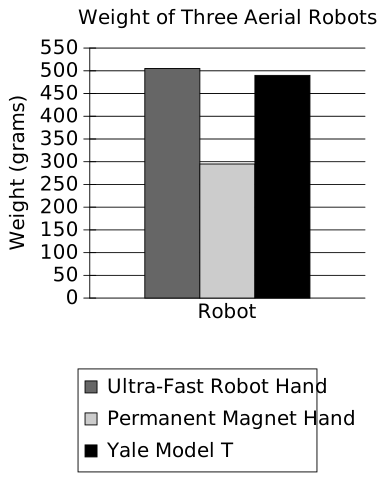
- The data for the 3 categories are as follows:
- Ultra-Fast Robot Hand: 505 grams
- Permanent Magnet Hand: 295 grams
- Yale Model T: 490 grams
Aerial robots vary considerably in their holding force; the Ultra-Fast Robot Hand, for example, has a holding force of 56 newtons, more than twice that of the Permanent Magnet Hand and more than four times that of the Yale Model T. Since an aerial robot must lift its own weight along with its cargo, engineer Jiawei Meng and colleagues used a ratio of each robot’s holding force to the robot’s weight to calculate payload capacity, with higher ratios corresponding to greater capacity, concluding that the Ultra-Fast Robot Hand has a higher payload capacity than the Yale Model T.
Which choice best describes data in the graph that support Meng and colleagues’ conclusion?
Explanation
Choice D is the best answer because it describes data in the graph that support Meng and colleagues’ conclusion that the Ultra-Fast Robot Hand has a higher payload capacity than the Yale Model T. According to the text, payload capacity is calculated by using a ratio of a robot’s holding force to the robot’s weight, and higher ratios indicate a greater payload capacity. The Ultra-Fast Robot Hand has a holding force of 56 newtons, four times greater than that of the Yale Model T. Additionally, the graph shows that the Ultra-Fast Robot Hand has a weight of approximately 500 grams, slightly more than the Yale Model T’s weight of approximately 480 grams. Therefore, the Ultra-Fast Robot Hand has a higher ratio of holding force to weight than the Yale Model T. Since higher ratios correspond to greater payload capacity, the information from the graph indicating that the Ultra-Fast Robot Hand weighs only slightly more than the Yale Model T combined with the information in the text ultimately supports the conclusion that the Ultra-Fast Robot Hand has a higher payload capacity than the Yale Model T.
Choice A is incorrect. Although, according to the graph, it’s true that both the Ultra-Fast Robot Hand and the Yale Model T weigh more than 450 grams, this statement doesn’t support Meng and colleagues’ conclusion that the Ultra-Fast Robot Hand has a higher payload capacity than the Yale Model T. This statement emphasizes a similarity, not a distinction, between the two robots. Choice B is incorrect. Although, according to the graph, it’s true that the Ultra-Fast Robot Hand and the Yale Model T both weigh more than the Permanent Magnet Hand does, this statement doesn’t support Meng and colleagues’ conclusion that the Ultra-Fast Robot Hand has a higher payload capacity than the Yale Model T. This statement emphasizes a similarity, not a distinction, between the Ultra-Fast Robot Hand and the Yale Model T. Furthermore, the comparison to the Permanent Magnet Hand is irrelevant to the claim about the relative ratios and payload capacities of the Ultra-Fast Robot Hand and the Yale Model T. Choice C is incorrect. Although the text states that the Yale Model T has a lower holding force than the Permanent Magnet Hand, the graph provides no information about holding force. Moreover, information about the Permanent Magnet Hand is irrelevant to the conclusion by Meng and colleagues, which only concerns the Ultra-Fast Robot Hand and the Yale Model T.